A traditional Finnish sauna is usually heated to between 80 and 100°C, measured at face height on the top bench, with dry air of around 10 to 20% humidity. That is the range described in long-running Finnish research on sauna bathing. An infrared sauna runs much cooler, typically around 45 to 60°C, because it warms your body directly rather than heating the air. You can read more about how that works in our guide to what an infrared sauna is.
Those numbers are a starting point, not a target. How hot a sauna should be for you depends on where you sit, how much steam you make and how used to the heat you are. This sauna temperature guide explains each of those.
How hot is a sauna? The short answer
- Traditional sauna: 80 to 100°C at face height, with dry air between rounds of steam.
- Infrared sauna: around 45 to 60°C air temperature, with radiant heat from panels.
- In Fahrenheit: 80 to 100°C is roughly 176 to 212°F, and 45 to 60°C is roughly 113 to 140°F.
You do not need to run a traditional sauna at the top of the range to enjoy it. Many people prefer the lower end, especially when they are starting out.
Why the temperature changes with height
Heat rises, so a sauna is never the same temperature from floor to ceiling. The air near your feet can be far cooler than the air around your head. This is why sauna benches are built high. HUUM, the heater maker, recommends a top bench around 105 cm from the floor, with 110 to 130 cm of space above it, so that you sit in the hot layer and the steam can spread properly.
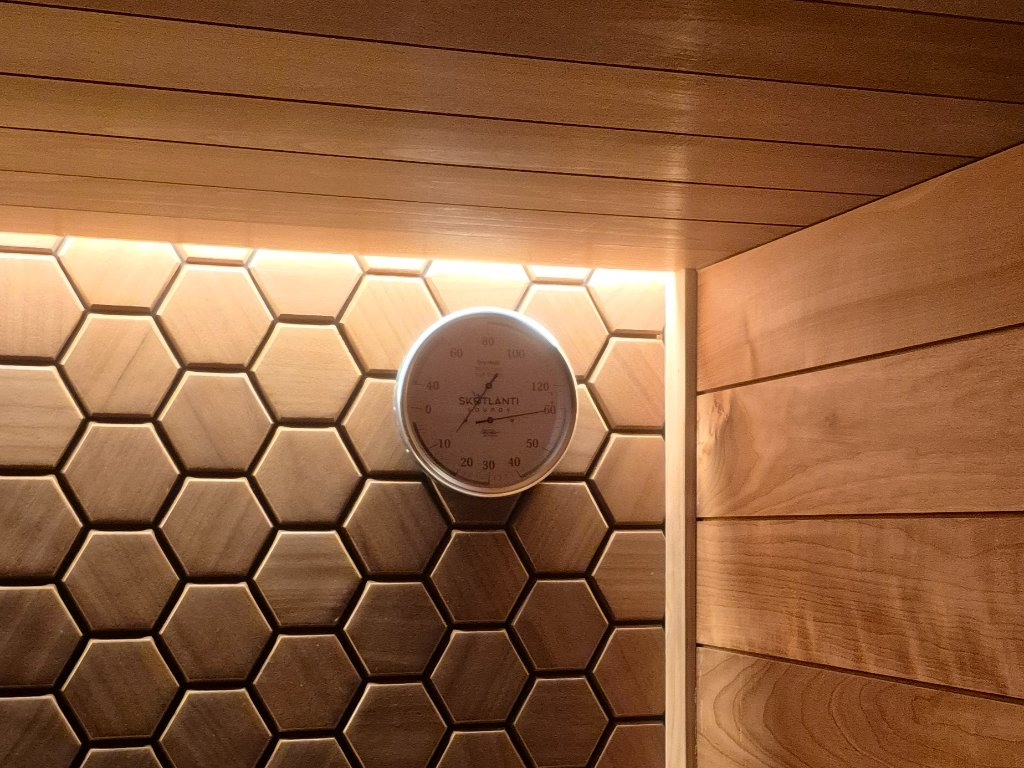
In practice, this gives you a simple way to control the heat. Sit on the top bench for the full experience, or move down a level if it feels too intense. It also means the number on your thermometer depends on where it is mounted, so get to know how your own sauna reads. Our indoor, outdoor and container saunas come with a Skotlanti thermometer and hygrometer as standard, so you can see both temperature and humidity at a glance.
Temperature and humidity: what löyly does
Temperature is only half of how hot a sauna feels. When you ladle water onto the hot stones, you create a wave of steam that Finns call löyly. As the Finnish researchers note, throwing water on the stones raises the humidity for a short time, and the sauna instantly feels hotter on your skin even though the thermometer barely moves.
That is why a sauna at 80°C with regular löyly can feel more intense than one at 90°C with none. If the heat feels too sharp, use less water. If it feels flat, add a ladle or two.
Finding the right temperature for you
- If you are new to saunas, start at the lower end of the range, sit on a lower bench and keep your first sessions short. Build up over a few weeks as you get used to the heat.
- If you are a regular, you will probably enjoy the upper end of the range on the top bench, with löyly to taste.
- If you are sharing, set the sauna for the person who likes it coolest, and let others move up a bench.
Whatever the temperature, the rule is the same: leave when you have had enough, not when the timer says so. Our beginner’s guide to using a sauna covers the full routine of heat, cool-down and rest, and our guide to how often to use a sauna covers frequency.
Setting the temperature on a home sauna
With an electric heater, you set the temperature on the control panel and the thermostat holds it there. A Wi-Fi controller such as the HUUM UKU, available with the HUUM heaters on our outdoor models, lets you start heating from your phone so the sauna is ready when you are.
A wood-fired stove takes more skill. You control the heat by how much wood you add and how you manage the air. HUUM warns that an oversized stove can overheat the room before the stones are hot enough to make good steam, which is one reason correct sizing matters. Our guide to wood-fired vs electric sauna heaters compares the two.
Either way, the heater has to suit the size of the room. The usual starting point is one kilowatt of heater power for each cubic metre of sauna, with extra allowed for glass. A heater that is too small will never quite reach temperature, however long you wait.
Does a hotter sauna have more benefits?
Most of the research on sauna and health comes from Finland, where a 2018 review of the evidence describes traditional sauna bathing as brief exposure to 80 to 100°C. That does not mean hotter is better. The studies looked at how often and how long people used the sauna as well as the heat, and a comfortable session you repeat regularly is worth more than one you endure. Our article on sauna benefits and what the evidence says goes into the detail, and we also look at using a sauna after a workout.
Staying safe in the heat
A sauna is safe for most healthy adults when used sensibly. Drink water before and after, and get out straight away if you feel dizzy, sick or develop a headache, as these can be early signs of heat exhaustion. If you are pregnant, have a heart condition or take medication that affects how you cope with heat, speak to your GP or midwife before using a sauna.
Sauna temperature: common questions
What temperature should a sauna be for beginners?
Start at the lower end of the traditional range and sit on a lower bench, where it is cooler. Keep sessions short at first and build up as you get used to the heat.
Is 100°C too hot for a sauna?
100°C is at the top of the traditional range. Experienced sauna users often enjoy it, but there is no need to go that high. If it feels uncomfortable, lower the thermostat, move down a bench or use less water on the stones.
What temperature should an infrared sauna be?
Infrared saunas usually run at around 45 to 60°C. Because the panels warm you directly, you sweat at a lower air temperature than in a traditional sauna. Our comparison of infrared and traditional saunas explains the difference.
How long does a sauna take to heat up?
It depends on the size of the room, the power of the heater, the amount of stone and how cold it is outside. A correctly sized heater in a well-insulated sauna heats up much faster than an undersized one, which is why heater sizing matters as much as the heater itself.
Find a sauna that holds its heat
A sauna that reaches and holds the right temperature starts with good insulation and a correctly sized heater. Our outdoor saunas are built with 175 mm walls insulated with British sheep wool, and every model is fitted with a heater matched to its size. Explore our outdoor saunas and indoor saunas, or get in touch with our team with any questions.