2-Person Outdoor Saunas: Compact Options for Smaller Gardens

If you have a smaller garden, or the sauna is mainly for you and a partner, a 2 person outdoor sauna sounds like the obvious choice. It can be the right one. But “2-person” is a label, not a measurement, and two cabins sold under the same label can feel very different to sit in.

This guide explains what to look for in a compact garden sauna, how small you can sensibly go, and the planning points that matter most for small outdoor buildings.

What “2-person” really means

A capacity figure is usually worked out from bench length. HUUM, the heater maker, recommends about 60 cm of sitting space per person, on benches at least 60 cm deep. So a true 2-person sauna needs a bench of at least 1.2 metres.

That gives two people room to sit upright side by side. It does not give either of you room to lie down, and lying down is one of the great pleasures of a sauna. For that you need a bench at least as long as you are tall. Before you buy any compact sauna, ask for the internal bench length and depth rather than relying on the number of people.

Why a little more space often pays off

In a small garden every square metre counts, but the difference between a cramped two-seater and a comfortable cabin is often less than you think. A slightly larger sauna lets you stretch out, have a friend or family member join you, and move between a higher and lower bench to control the heat.

It also tends to feel better to sit in. Sauna benches are built high, with about 110 to 130 cm of space between the top bench and the ceiling, and a cabin with room for proper benches gives you a much better heat than one built only to hit a capacity number.

Our most compact outdoor sauna: Ylänkö

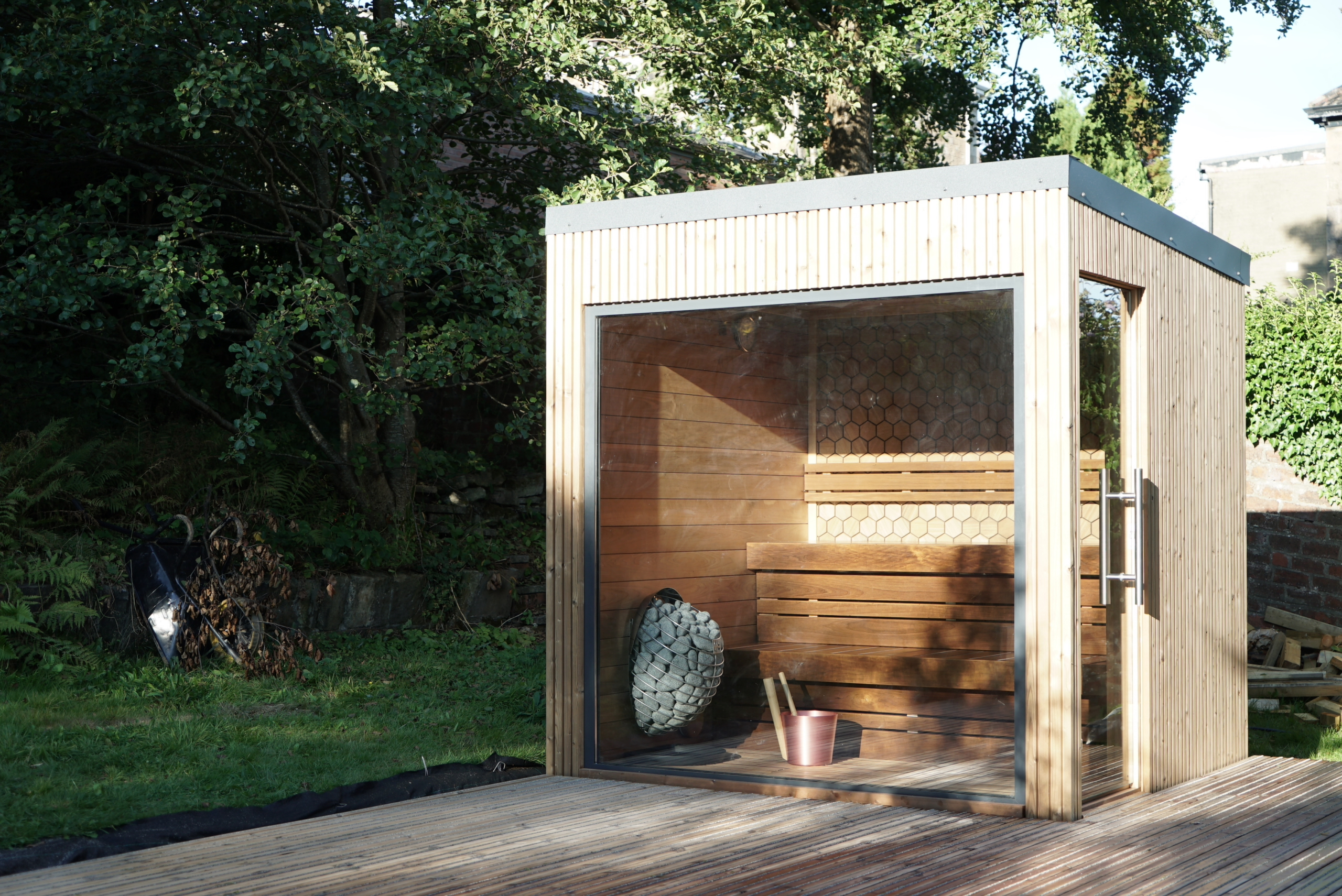
Our Ylänkö garden sauna is the smallest of our standard outdoor models. It measures 210 cm by 219.5 cm on the ground and stands 249 cm at its highest point, yet seats up to five, so two people have room to spread out.

It is built the same way as our larger models:

  • Thermally treated ash cladding and interior, with aspen benches
  • 175 mm walls insulated with British sheep wool
  • A tinted, aluminium-framed glazed front measuring 180 by 140 cm for light and privacy
  • A steel roof and a steel base with adjustable legs
  • A HUUM Drop 9 kW electric heater with UKU Wi-Fi control, or a JUUP Iivari Punos wood-burning stove for an extra £1,300

Ylänkö starts from £30,000 including VAT. If you have a little more room, our Saari and Tähti models add a porch. You can compare all three on our outdoor saunas page.

Going smaller with a bespoke build

If Ylänkö is still too large for your garden, a bespoke sauna can be designed around the space you have, with the benches, glazing and heater chosen to suit. Every design starts with your measurements and a few photos, and we provide a layout and quote within a week. See how our bespoke sauna service works.

Planning rules for compact garden saunas

Small saunas are often the easiest to build without planning permission, but size and position still matter, and the rules differ across the UK.

Our full guide to planning permission for a garden sauna explains the rules in plain English.

Where to put a compact sauna

A smaller footprint gives you more choice of spot, but the basics stay the same. You need firm, level ground, a power supply or space for a flue, and enough room around the sauna to reach the walls for maintenance. A short, sheltered path from the house makes a big difference on a winter evening. Our guide to the best location for an outdoor sauna covers ground, shelter, privacy and trees.

Heating a small outdoor sauna

A smaller sauna has less air to heat, so it needs less heater power and warms up faster. The usual rule is one kilowatt of heater power for each cubic metre, with extra allowed for glass. Large glazed fronts look wonderful in a garden, but they add to the heater size you need, so the heater should always be matched to the whole design.

Choosing between electric and wood-fired is the other big decision. Our guide to wood-fired vs electric sauna heaters sets out the pros and cons, and our guide to sauna running costs shows what a session costs.

2-person outdoor saunas: common questions

How big is a 2-person outdoor sauna?

Inside, it needs a bench of at least 1.2 metres and a ceiling of around 2.1 metres. The outside footprint depends on the wall thickness, glazing and whether there is a porch. Always compare internal bench sizes, not just the external dimensions.

Do I need planning permission for a small garden sauna?

Often not, as long as it meets the permitted development limits on height, position and footprint. Conservation areas, listed buildings and wood-fired stoves can change that, so check the rules for your property.

How much does a small outdoor sauna cost?

Our most compact outdoor model, Ylänkö, starts from £30,000 including VAT. Bespoke saunas are quoted individually, and most residential bespoke projects fall between £20,000 and £60,000. Our sauna cost guide explains what affects the price.

Can a small outdoor sauna be wood-fired?

Yes. A wood-burning stove works well in a compact sauna as long as it is sized for the room and there is a safe route for the flue. Check whether you live in a smoke control area before you choose.

Find the right size for your garden

A compact sauna should still feel like a proper sauna. Read our complete UK guide to garden saunas, explore our outdoor saunas, or send us your garden measurements and we will help you find what fits.

Sauna Buying Guide: How to Choose the Right Sauna

Buying a sauna is a big decision, and the first few choices you make (where it goes, how it is heated and how big it is) shape everything that follows. This sauna buying guide takes you through what to look for, in the order we suggest you think about it, so that when you buy a sauna it is one you will still be using happily in twenty years.

We design and build saunas in our Glasgow workshop, so we have seen what separates a sauna people use every week from one that ends up as a very expensive garden store. Most of it comes down to the points below.

Decide where it will go: indoors or outdoors

Start with location, because it decides almost everything else. An outdoor sauna is a small building in its own right. It needs a firm, level base, a power supply or a flue, and a spot you will happily walk to on a cold evening. In return you get a separate retreat, often with a view. Our guide to choosing the best spot for an outdoor sauna covers the ground, shelter and privacy questions in detail.

An indoor sauna is built into a room you already have: a basement, a home gym, a spare room or an en-suite. Here the limits are the room itself, especially ceiling height and the route in for materials. See where to put an indoor sauna in your home for a room-by-room look, and our complete guide to home saunas in the UK for the wider picture.

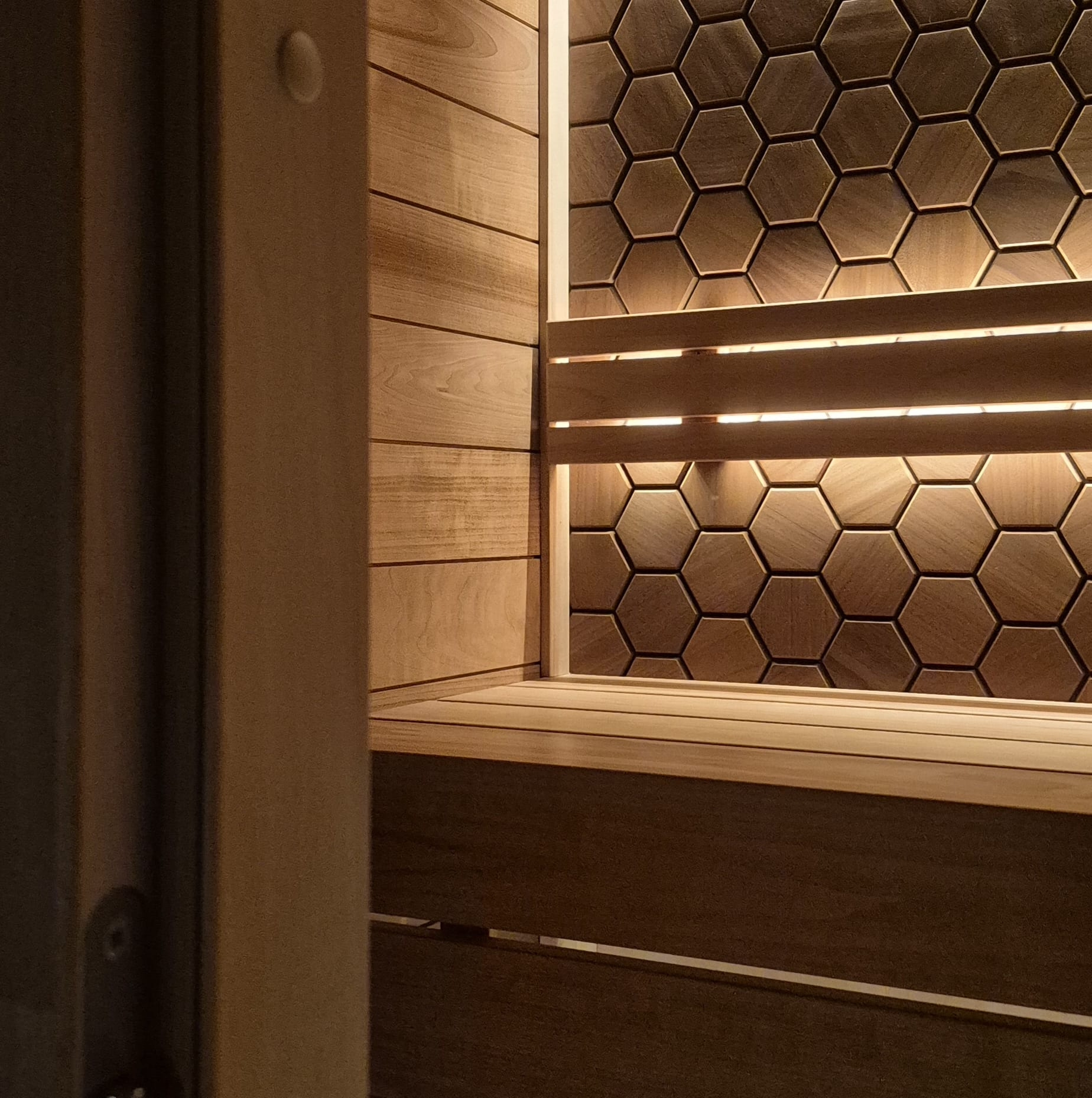
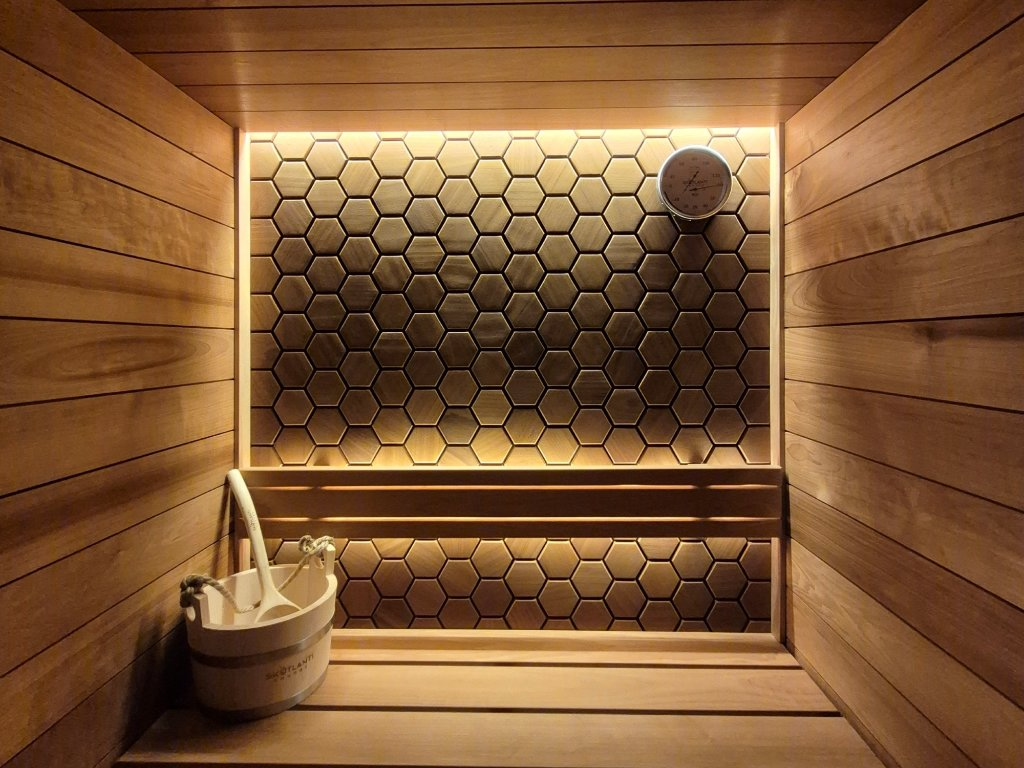
Interior of a Skotlanti Talo indoor sauna with aspen benches, a hexagonal wall panel and soft under-bench lighting

Choose the type of heat: traditional or infrared

A traditional Finnish sauna heats the air with a stove and a bed of stones. Pour water on the stones and you get a burst of steam, known as löyly. Finnish research describes a typical sauna as running at 80 to 100°C at the level of the bather’s face, with dry air between rounds of steam.

An infrared sauna works differently. Panels warm your body directly while the air stays much cooler. Both have their fans, and our comparison of infrared vs traditional saunas sets out the differences honestly. All six of our standard models are traditional saunas heated by a stove and stones.

Electric or wood-fired

Within traditional saunas, the next choice is the heater. An electric heater is the easy option day to day: you set the temperature, and with a Wi-Fi controller such as the HUUM UKU you can start heating the sauna from your phone before you get home. It needs a suitable electrical supply, which we cover below.

A wood-fired stove needs no electricity to run and brings the crackle and smell of a real fire. It also needs a flue, somewhere dry to store logs, and a little more time. If you live in a smoke control area, check which stoves and fuels are allowed before you choose. Our guide to wood-fired vs electric sauna heaters goes through the trade-offs. Our outdoor models are available with either: an electric heater as standard, or a JUUP Iivari Punos wood-burning stove for an extra £1,300.

Get the size right

Think about how many people will use the sauna at the same time, and whether you want room to lie down. HUUM, the Estonian heater maker, recommends about 60 cm of bench per person and benches at least 60 cm deep, with the top bench around 105 cm from the floor and 110 to 130 cm of space above it so the steam can circulate.

That is why the number of people a sauna “seats” only tells you part of the story. Ask for the bench lengths and depths, not just the headline capacity. If you want to stretch out, you need a bench at least as long as you are tall. Our guide to how much space you need for a home sauna works through the numbers.

Match the heater to the room

A heater that is too small will struggle to reach temperature. One that is too large can make the room uncomfortable before the stones are hot enough for good steam. The usual starting point is one kilowatt of heater power for each cubic metre of sauna, with extra volume added for glass and other uninsulated surfaces.

A good builder will do this calculation for you. As a guide to what that looks like in practice, our compact Talo indoor sauna pairs with HUUM CORE wall heaters from 3 kW to 4 kW, while our larger outdoor models use 9 kW HUUM heaters or a 10.2 kW Tulikivi Nobile.

Look closely at materials and build quality

Two saunas can look alike in photos and be very different to sit in. When you compare suppliers, ask about:

  • Timber: what the cladding, lining and benches are made from, and whether the timber is certified. Our outdoor models use thermally treated ash and aspen, and all of our timber sources are PEFC certified.
  • Wall build and insulation: how thick the walls are and what is inside them. Our outdoor saunas have 175 mm walls insulated with British sheep wool.
  • Glazing: whether windows and doors are double glazed. Ours use aluminium-framed double glazing.
  • Roof and base: what keeps the weather out and how the sauna sits on the ground. Our outdoor models have a steel roof and a steel base with adjustable legs.
  • Who builds it: whether the sauna is made by the company selling it, or imported as a kit.

Plan the practical bits: power, base and planning

Most electric saunas need their own circuit. In England, installing a new circuit is notifiable building work under Part P, so use a registered electrician who can certify it. In Scotland, electrical work must meet the building standards, and where a building warrant is needed it can be signed off by an Approved Certifier of Construction.

An outdoor sauna also needs a solid, level base, and you should measure the delivery route before you settle on a spot. Most garden saunas can be built without planning permission, but height near a boundary matters and the rules differ between Scotland and England. Our guide to planning permission for a garden sauna explains both in plain English.

Budget for the whole project

The sauna is the largest cost, but not the only one. Allow for groundwork, electrical work or a flue, delivery and installation. As a guide, these are our published starting prices including VAT as of November 2026:

  • Talo compact indoor sauna: from £7,600
  • Ylänkö garden sauna: from £30,000
  • Saari outdoor sauna with porch: from £37,000
  • Tähti outdoor sauna with porch and star lights: from £45,000
  • Meri mobile sauna: from £45,000
  • Container sauna for up to 12 people: from £49,000
  • Bespoke saunas: most residential projects fall between £20,000 and £60,000

Our guide to how much a sauna costs in the UK breaks down where the money goes, and our guide to what a sauna costs to run covers the ongoing side.

Ask about warranty, lead times and aftercare

Before you sign, find out what is covered and for how long, who installs the sauna, and what happens if something goes wrong. Our heaters carry a five year warranty, our outdoor saunas come with a warranty on the build, and we deliver and install across mainland UK. For bespoke projects we provide a layout and quotation within a week of receiving your measurements.

Off-the-shelf or bespoke?

A standard model is built to a proven specification and a fixed price. A bespoke sauna is designed around your space, so it can fit an awkward room, match your architecture or squeeze into a smaller garden. Our article on bespoke vs off-the-shelf saunas compares the two, and you can see how our bespoke sauna design service works.

Your sauna buying checklist

  • Where will it go, and how will you get to it in winter?
  • Traditional or infrared heat?
  • Electric or wood-fired, and is your property in a smoke control area?
  • How many people at once, and do you want to lie down?
  • Is the heater sized for the room, including any glass?
  • What are the walls, insulation, glazing, roof and base made of?
  • Do you have a suitable power supply, base and access route?
  • Do you need planning permission or a building warrant?
  • What is the total budget, including installation and running costs?
  • What warranty and aftercare come with it?

Sauna buying guide: common questions

What should I look for when buying a sauna?

Look at where it will go, the type of heat, the size of the benches, whether the heater suits the room, and how the sauna is built. Then check the practical side: power, base, planning and warranty. A cheaper sauna that is too small or poorly insulated is often the more expensive choice in the long run.

Is an indoor or outdoor sauna better?

Neither is better in itself. An outdoor sauna gives you a separate retreat and suits homes with garden space. An indoor sauna suits homes with a spare room, basement or large bathroom, and you never have to step outside to reach it. Browse our outdoor saunas and indoor saunas to compare.

What size sauna do I need?

Allow about 60 cm of bench for each person who will use it at the same time, and a longer bench if you want to lie down. Then make sure the heater is sized to the volume of the room.

How long does a well-built sauna last?

A well-built outdoor sauna made from thermally treated timber typically lasts 20 years or more with basic maintenance, which is what we build our outdoor saunas to achieve. Build quality and regular care make the biggest difference.

Talk to the people who build them

If you are weighing up your options, we are happy to talk them through, with no pressure. Explore our Ylänkö, Saari and Tähti outdoor models, our Talo compact indoor sauna, or get in touch with our team to book a visit to our Glasgow showroom.

How Hot Should a Sauna Be? A Sauna Temperature Guide

A traditional Finnish sauna is usually heated to between 80 and 100°C, measured at face height on the top bench, with dry air of around 10 to 20% humidity. That is the range described in long-running Finnish research on sauna bathing. An infrared sauna runs much cooler, typically around 45 to 60°C, because it warms your body directly rather than heating the air. You can read more about how that works in our guide to what an infrared sauna is.

Those numbers are a starting point, not a target. How hot a sauna should be for you depends on where you sit, how much steam you make and how used to the heat you are. This sauna temperature guide explains each of those.

How hot is a sauna? The short answer

  • Traditional sauna: 80 to 100°C at face height, with dry air between rounds of steam.
  • Infrared sauna: around 45 to 60°C air temperature, with radiant heat from panels.
  • In Fahrenheit: 80 to 100°C is roughly 176 to 212°F, and 45 to 60°C is roughly 113 to 140°F.

You do not need to run a traditional sauna at the top of the range to enjoy it. Many people prefer the lower end, especially when they are starting out.

Why the temperature changes with height

Heat rises, so a sauna is never the same temperature from floor to ceiling. The air near your feet can be far cooler than the air around your head. This is why sauna benches are built high. HUUM, the heater maker, recommends a top bench around 105 cm from the floor, with 110 to 130 cm of space above it, so that you sit in the hot layer and the steam can spread properly.

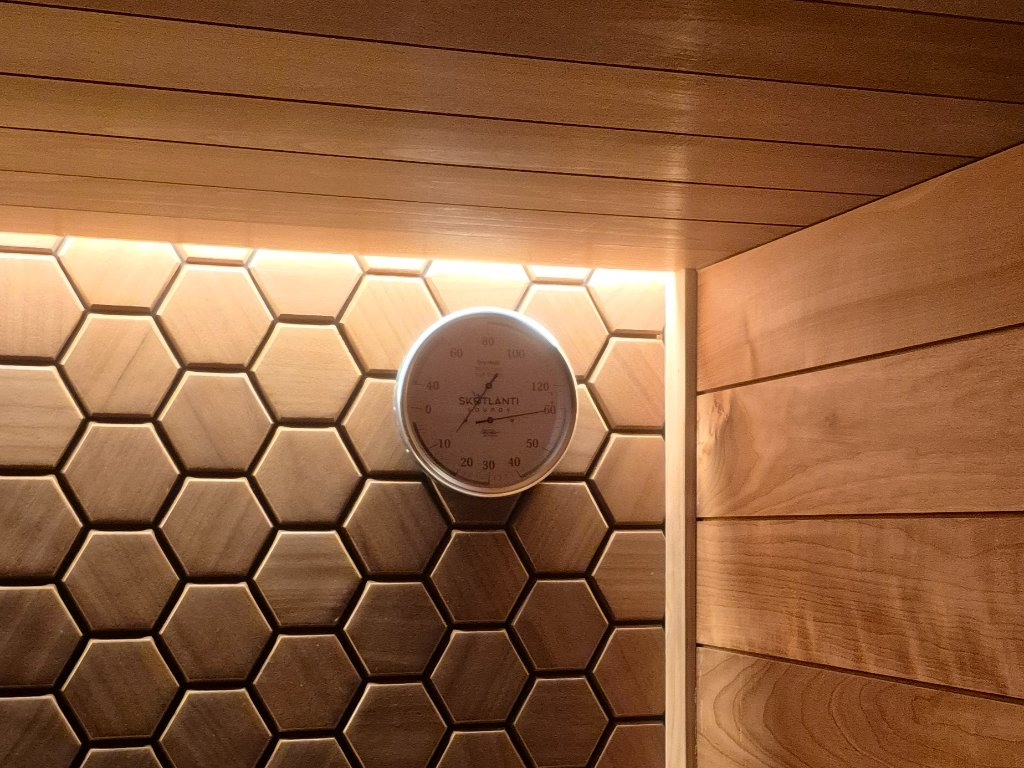
In practice, this gives you a simple way to control the heat. Sit on the top bench for the full experience, or move down a level if it feels too intense. It also means the number on your thermometer depends on where it is mounted, so get to know how your own sauna reads. Our indoor, outdoor and container saunas come with a Skotlanti thermometer and hygrometer as standard, so you can see both temperature and humidity at a glance.

Skotlanti thermometer and hygrometer mounted on a hexagonal wall panel inside a sauna

Temperature and humidity: what löyly does

Temperature is only half of how hot a sauna feels. When you ladle water onto the hot stones, you create a wave of steam that Finns call löyly. As the Finnish researchers note, throwing water on the stones raises the humidity for a short time, and the sauna instantly feels hotter on your skin even though the thermometer barely moves.

That is why a sauna at 80°C with regular löyly can feel more intense than one at 90°C with none. If the heat feels too sharp, use less water. If it feels flat, add a ladle or two.

Finding the right temperature for you

  • If you are new to saunas, start at the lower end of the range, sit on a lower bench and keep your first sessions short. Build up over a few weeks as you get used to the heat.
  • If you are a regular, you will probably enjoy the upper end of the range on the top bench, with löyly to taste.
  • If you are sharing, set the sauna for the person who likes it coolest, and let others move up a bench.

Whatever the temperature, the rule is the same: leave when you have had enough, not when the timer says so. Our beginner’s guide to using a sauna covers the full routine of heat, cool-down and rest, and our guide to how often to use a sauna covers frequency.

Setting the temperature on a home sauna

With an electric heater, you set the temperature on the control panel and the thermostat holds it there. A Wi-Fi controller such as the HUUM UKU, available with the HUUM heaters on our outdoor models, lets you start heating from your phone so the sauna is ready when you are.

A wood-fired stove takes more skill. You control the heat by how much wood you add and how you manage the air. HUUM warns that an oversized stove can overheat the room before the stones are hot enough to make good steam, which is one reason correct sizing matters. Our guide to wood-fired vs electric sauna heaters compares the two.

Either way, the heater has to suit the size of the room. The usual starting point is one kilowatt of heater power for each cubic metre of sauna, with extra allowed for glass. A heater that is too small will never quite reach temperature, however long you wait.

Does a hotter sauna have more benefits?

Most of the research on sauna and health comes from Finland, where a 2018 review of the evidence describes traditional sauna bathing as brief exposure to 80 to 100°C. That does not mean hotter is better. The studies looked at how often and how long people used the sauna as well as the heat, and a comfortable session you repeat regularly is worth more than one you endure. Our article on sauna benefits and what the evidence says goes into the detail, and we also look at using a sauna after a workout.

Staying safe in the heat

A sauna is safe for most healthy adults when used sensibly. Drink water before and after, and get out straight away if you feel dizzy, sick or develop a headache, as these can be early signs of heat exhaustion. If you are pregnant, have a heart condition or take medication that affects how you cope with heat, speak to your GP or midwife before using a sauna.

Sauna temperature: common questions

What temperature should a sauna be for beginners?

Start at the lower end of the traditional range and sit on a lower bench, where it is cooler. Keep sessions short at first and build up as you get used to the heat.

Is 100°C too hot for a sauna?

100°C is at the top of the traditional range. Experienced sauna users often enjoy it, but there is no need to go that high. If it feels uncomfortable, lower the thermostat, move down a bench or use less water on the stones.

What temperature should an infrared sauna be?

Infrared saunas usually run at around 45 to 60°C. Because the panels warm you directly, you sweat at a lower air temperature than in a traditional sauna. Our comparison of infrared and traditional saunas explains the difference.

How long does a sauna take to heat up?

It depends on the size of the room, the power of the heater, the amount of stone and how cold it is outside. A correctly sized heater in a well-insulated sauna heats up much faster than an undersized one, which is why heater sizing matters as much as the heater itself.

Find a sauna that holds its heat

A sauna that reaches and holds the right temperature starts with good insulation and a correctly sized heater. Our outdoor saunas are built with 175 mm walls insulated with British sheep wool, and every model is fitted with a heater matched to its size. Explore our outdoor saunas and indoor saunas, or get in touch with our team with any questions.

How Much Space Do You Need for a Home Sauna?

Less than most people expect. A home sauna is sized around its benches, not around the room it sits in, and a compact sauna for one or two people can fit into a corner of a basement, a home gym or even a large bathroom. We build bespoke saunas into spaces starting from around 3 m², such as a utility area or a wardrobe space.

What matters more than the floor area is getting a handful of dimensions right: the length and depth of the benches, the height of the ceiling, room for the heater and a way to get the materials in. This guide to home sauna size takes each one in turn.

Start with the benches

The benches decide how many people the sauna holds and how comfortable it feels. HUUM, the heater maker, recommends about 60 cm of sitting space per person and benches at least 60 cm deep. So two people sitting side by side need a bench of roughly 1.2 metres, and four people need about 2.4 metres, either on one long bench or split across an L-shape.

If you want to lie down, you need at least one bench as long as you are tall. That single decision often adds more to the footprint than an extra seat does, so it is worth deciding early whether lying down matters to you.

Ceiling height matters as much as floor area

Because heat rises, a sauna works vertically. HUUM puts the normal sauna height at 2,100 to 2,300 mm, with a minimum of 2,000 mm. The top bench sits about 105 cm from the floor, with 110 to 130 cm of space above it so the steam can spread and you sit in the hottest air.

If your room is taller than that, the sauna is usually built with its own lower ceiling. That is not a compromise: a lower ceiling means less air to heat, so the sauna warms up faster and needs a smaller heater. If your room is lower than about two metres, a traditional sauna becomes difficult, and it is worth talking to a builder before you plan around it.

Leave room for the heater

The heater takes up wall or floor space, and every heater comes with safety clearances set out in the manufacturer’s installation manual. These are not optional, so they need to be in the plan from the start.

The size of the room also decides the size of the heater. The usual rule is one kilowatt of heater power for each cubic metre, with extra volume added for glass and other uninsulated surfaces. A sauna measuring 1.5 m by 1.8 m inside, with a 2.1 m ceiling, has a volume of about 5.7 cubic metres, so it would need a heater of around 6 kW before any allowance for glass. For a sense of scale, our compact Talo indoor sauna pairs with HUUM CORE wall-mounted heaters from 3 kW to 4 kW, which take up very little room.

How much space for how many people?

As a rough guide, working from the bench measurements above:

  • One or two people: a single bench of 1.2 m or more. Ideal for a corner of a spare room, a home gym or a bathroom conversion.
  • Three or four people: benches totalling around 1.8 to 2.4 m, often in two tiers or an L-shape.
  • Larger groups: longer or wraparound benches, and a correspondingly larger heater.

Our Talo indoor sauna comes in 1 to 2 person, 3 person and 4 person layouts, and our indoor saunas are configured to your room, ceiling height and access.

Think about the space around the sauna

The sauna itself is only part of the footprint. You also need to plan for:

  • The door: how it opens, and space to step in and out comfortably.
  • Access: how the parts get into the room, including stairs, corridors and door widths.
  • Power: an electric heater normally needs its own circuit, so note where your consumer unit is.
  • Ventilation: fresh air in and out, which a good builder designs in from the start.
  • Somewhere to cool down: a shower, a seat or simply a cooler room to step into between rounds.

Our guide to where to put an indoor sauna looks at basements, garages, spare rooms and bathrooms in more detail.

Outdoor saunas: footprint plus clearance

For a garden sauna, the footprint is the building itself plus room to walk around it for maintenance. Our three outdoor models give a sense of scale:

  • Ylänkö: 210 cm by 219.5 cm, seats 5
  • Saari: 282 cm by 232 cm with a porch, seats 5
  • Tähti: 210 cm by 345 cm with a side porch, seats 5

All three stand 249 cm at their highest point. Siting, ground and planning rules are covered in our guides to the best location for an outdoor sauna and planning permission for a garden sauna.

Measuring your space: a quick checklist

  • Internal length and width of the space
  • Ceiling height, and any beams, slopes or pipes
  • Door and access route widths, including any stairs
  • Where the nearest power supply and consumer unit are
  • What the floor is made of and whether it is level
  • Any windows, and which way they face

Send us these measurements with a few photos and we can tell you what will fit.

Home sauna size: common questions

What is the smallest size for a home sauna?

A sauna for one or two people needs a bench of around 1.2 m and a ceiling of at least 2 m. We build bespoke saunas into spaces from around 3 m², which is smaller than many people expect.

How high should a sauna ceiling be?

Normally between 2.1 and 2.3 metres, with a minimum of around 2 metres. Higher ceilings mean more air to heat, so taller rooms usually get a lowered sauna ceiling.

Can I put a sauna in a bathroom?

Yes. A sauna can replace a bath or shower to create a compact wellness space within an existing bathroom. It needs proper planning for power, ventilation and moisture, so it is a job for a specialist rather than a kit.

Does a bigger sauna cost more to run?

Generally, yes. A larger room needs a more powerful heater and takes more energy to bring up to temperature. Our guide to sauna running costs shows how size, heater power and use add up.

Find out what fits your space

Every home is different, and the best way to know what will fit is to measure up and talk it through. Read our complete guide to home saunas in the UK, see how our bespoke sauna design service works, or send us your measurements and we will come back with a layout.