One of the first questions people ask once they start pricing up a home sauna is what it will cost to run. The good news is that the answer is usually smaller than expected. For most electric saunas in the UK, a session costs somewhere between a few pence and a few pounds, depending on the type of sauna, the size of the heater and how long you use it. This guide shows you how to work out the real number for your own sauna, with worked examples at current UK electricity prices.
The simple formula
Every electric sauna follows the same sum:
heater power (kW) x hours switched on x your electricity unit rate = cost per session
The heater’s power rating is on its spec sheet. The unit rate is on your electricity bill. For reference, the Ofgem price cap from 1 October to 31 December 2026 sets an average electricity unit rate of 26.32p per kWh for customers paying by direct debit. Your own tariff may be higher or lower, and the cap changes every quarter, so it is always worth plugging in your own figure.
What a session really costs
The figures below are a ceiling, not an average. They assume the heater runs at full power for the whole time, from switching on to switching off, at 26.32p per kWh. In practice your sauna will cost less than this, because once the cabin reaches temperature the thermostat cycles the heater on and off to hold it there rather than running flat out.
- Infrared cabin (around 2 kW), one hour including warm-up: 2 kWh, so no more than about 53p a session.
- Traditional sauna with a 6 kW heater, 45 minutes to heat plus a 45 minute session: 9 kWh, so no more than about £2.37 a session.
- Larger traditional sauna with a 9 kW heater, an hour to heat plus an hour of use: 18 kWh, so no more than about £4.74 a session.
Used three times a week, that works out at no more than roughly £7 a month for the infrared cabin, £31 a month for the 6 kW sauna and £62 a month for the larger 9 kW build. If you are weighing up the two types of heat, our guide to how infrared saunas work explains why they draw so much less power.
What pushes the cost up or down
Heater size
Heaters are sized to the volume of the cabin. A heater that is too small has to work harder and for longer to reach temperature, while one that is properly matched heats the room efficiently and then idles. A bespoke build lets the heater be specified for the exact space rather than a standard box.
Insulation and build quality
This is the biggest factor most people overlook. A well-insulated, well-sealed cabin holds its heat, so the heater spends less time switched on during your session. Poor insulation, gaps around the door and thin walls all leak heat and money.
Indoor or outdoor
An outdoor sauna starts from a colder baseline in winter, so it takes longer to warm up on a cold Scottish evening than an indoor sauna sitting inside a heated house. Good insulation narrows that gap considerably.
How long you heat it before you get in
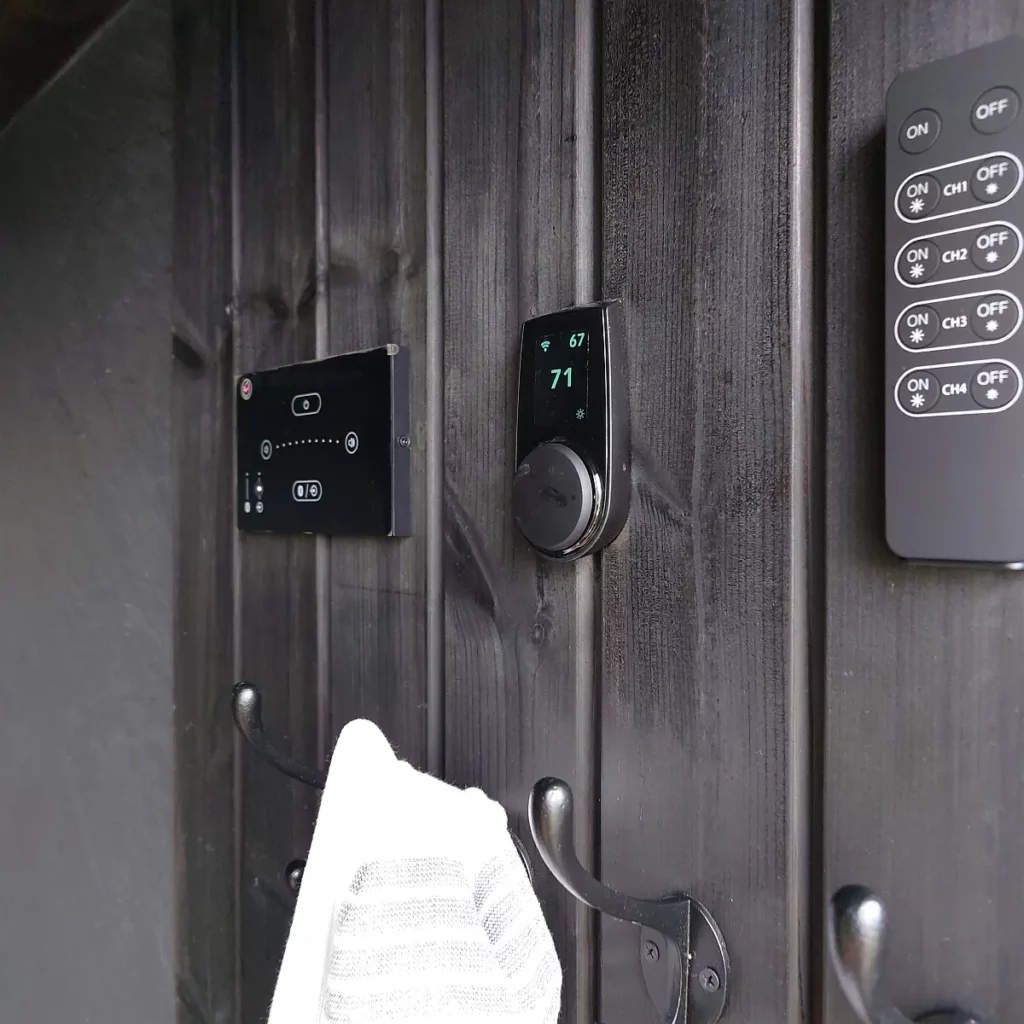
Warm-up is usually the most energy-hungry part of any session, because the heater runs at full power the whole time. Switching on at the right moment, ideally with a timer or app control, avoids paying to heat an empty sauna.
What about wood-fired saunas?
A wood-fired stove uses no electricity for heat, so the running cost is the cost of your logs. That can be very economical if you have a good local supply of seasoned hardwood, and it keeps working during a power cut. The trade-off is more hands-on effort to light and tend the fire. Our comparison of wood-fired vs electric sauna heaters covers the pros and cons in full.
The smaller ongoing costs
Beyond energy, the running costs of a sauna are modest. Sauna stones settle and crack over time and need replacing every so often, the timber benefits from regular cleaning and the occasional treatment, and an outdoor sauna needs its exterior looked after like any garden building. None of these are large, and a quality build keeps them to a minimum.
Five ways to keep running costs down
- Choose the right heater size for the cabin rather than the biggest one available.
- Invest in insulation and a well-sealed door. It pays back every session.
- Use a timer or remote control so the sauna is ready when you are, and not before.
- Keep the door closed while heating and between rounds.
- Share sessions with family or friends, since the warm-up cost is the same however many people use it.
Running costs in context
For most households, the running cost of a sauna is small next to the upfront cost of buying and installing one. Our UK sauna cost guide breaks down what to expect to pay for the sauna itself, and if you are wondering how many sessions to budget for, see how often you should use a sauna.
Sauna running costs: common questions
Does a sauna use a lot of electricity?
A traditional electric heater draws a lot of power while it is heating, typically 6 to 9 kW for a home sauna, but only for a short time. Because sessions are short and the thermostat cycles the heater once the room is hot, the total energy used per session is modest. For most households it is a small line on the bill rather than a large one.
Is an infrared sauna cheaper to run?
Yes. Infrared panels draw far less power than a traditional heater and warm up in a fraction of the time, so the cost per session is usually measured in pence. The experience is different, with gentler air temperatures and no steam, so it is worth comparing infrared and traditional saunas before deciding on cost alone.
Do I need a special electricity supply?
Most traditional sauna heaters need their own dedicated circuit, installed and certified by a qualified electrician. Smaller infrared cabins can sometimes run from a standard supply, but always follow the manufacturer’s specification. A reputable installer will confirm what your home needs as part of the design.
Can solar panels cover the cost?
If you have solar panels, running the sauna during daylight hours can use energy you have generated yourself, which reduces what you draw from the grid. How much it helps depends on the size of your system, the time of year and when you like to use the sauna.
A sauna built to be efficient
Skotlanti designs and builds bespoke indoor saunas and outdoor saunas with properly sized heaters and well-insulated cabins, so they are a pleasure to use and sensible to run. Get in touch with Skotlanti and we will help you find the right setup for your home.