Do Home Saunas Add Value to Your Property?

A home sauna is a lifestyle investment first, but it is natural to wonder whether it will also add value to your property when the time comes to sell. The honest answer is that it can, but how much depends on the quality of the sauna, how well it is integrated into the home and who is likely to buy it. This guide looks at when a sauna adds value, when it does not, and how to make sure yours is an asset rather than an afterthought.

The short answer

There is no reliable UK figure for exactly how much a sauna adds to a house price, and anyone who quotes a fixed percentage is guessing. What is clear is that a well-built, well-placed sauna can make a home more appealing, help it stand out from comparable properties and support a premium asking price, particularly at the upper end of the market. A poorly built or neglected one can do the opposite.

When a sauna adds the most value

When it looks like part of the home

A sauna that has been designed around the property, with materials and finishes that suit the house and garden, reads as a feature. One that looks like a temporary kit dropped onto the lawn reads as something the next owner may have to remove. This is where a bespoke build makes a real difference, and our guide to bespoke vs off-the-shelf saunas explains why.

When it is well placed

Location matters as much as the sauna itself. An indoor sauna in a sensible, well-ventilated spot, or a garden sauna that sits naturally in the landscape with a good path from the house, adds to how a buyer imagines living in the home. For ideas, see our room-by-room guide to where to put an indoor sauna.

When it suits the buyer

Wellness features carry most weight with buyers who were already looking for them. Larger family homes, rural and coastal properties, and homes in areas where outdoor living is part of the appeal tend to benefit most. In a compact starter home, buyers may value the space more than the sauna.

When it comes with the paperwork

Buyers and their solicitors like certainty. Keep the electrical installation certificate, any warranty and maintenance records, and confirmation that the build complied with planning rules. Most garden saunas do not need planning permission, and our guide to planning permission for a garden sauna explains when one does.

When a sauna may not add value

  • It is in poor condition. Tired timber, a failing heater or a damp cabin becomes a cost in the buyer’s mind, not a feature.
  • It takes up valuable space. A sauna that swallows a needed bedroom or most of a small garden may narrow your pool of buyers.
  • It does not match the property. A cheap-looking cabin on a premium home can detract from first impressions.

Lifestyle value comes first

The best reason to install a sauna is the years of use you get from it, not the price you might recover when you move. If you use it a few times a week, the value to you comes from better relaxation, recovery and time together long before resale enters the picture. Our complete guide to home saunas in the UK covers the full range of options, and our sauna cost guide sets out what to budget.

Thinking of selling?

If you plan to move, decide early whether the sauna stays with the house or comes with you, and make that clear in the sale. A freestanding garden sauna can sometimes be relocated, while a sauna built into the fabric of the home will normally stay. Either way, a clean, well-presented sauna photographs beautifully and gives your listing a feature that most comparable homes do not have.

Saunas and property value: common questions

Does a garden sauna count as part of the house?

It depends on how it is built. A sauna fixed to a permanent base and connected to the mains is usually treated as part of the property, while a freestanding cabin may be treated more like a garden building that could be moved. If you are selling, make it clear in the sale whether the sauna is included so there are no surprises later.

Will a sauna affect my home insurance?

It is worth telling your insurer about a new sauna, particularly a garden sauna or one with a wood-burning stove, so that it is properly covered as part of your buildings and outbuildings. Keep your installation certificates to hand, as they may be asked for.

Does an indoor or outdoor sauna add more value?

Neither is automatically better. A garden sauna adds an outdoor living feature without using space inside the house, while an indoor sauna can create a spa-like bathroom or wellness room. What matters most is that it suits the home and is built to a high standard.

Is a sauna worth it if I might move in a few years?

If you will use it regularly, the lifestyle value can make it worthwhile even over a few years. If resale is your main concern, choose a design that suits the property and keep it in excellent condition, so it is a selling point rather than a question mark for buyers.

Build a sauna that adds to your home

Skotlanti designs and builds bespoke saunas made to suit your home, your garden and the way you live. Get in touch with Skotlanti to talk through a sauna that is a pleasure to use today and an asset for years to come.

Best Location for an Outdoor Sauna in Your Garden

Where you put your outdoor sauna shapes how often you use it, how much it costs to install and how good it feels to sit in. A well-chosen spot makes the walk out on a cold evening part of the ritual. A poor one means a muddy path, a long cable run and a view of the neighbour’s fence. If you are wondering where to put an outdoor sauna, this guide walks through the practical questions to answer before you decide on the best location for it in your garden.

Firm, level ground

Every outdoor sauna needs a solid, level base that will not shift or hold water. Common options are a concrete slab, a paved base or ground screws, and the right choice depends on your soil, the slope of the garden and the size of the sauna. Avoid low spots where rainwater collects, and make sure water can drain away from the base rather than pooling against it.

A short, easy walk from the house

The closer the sauna is to the back door, the more you will use it, especially in winter. Think about the route you will walk in a towel on a dark, wet evening. A firm path, some low-level lighting and a sensible distance from the house all make a real difference to day-to-day use.

Access to power

An electric heater needs a dedicated supply run from your house by a qualified electrician. The further the sauna sits from your consumer unit, the longer and more expensive that cable run becomes. It is worth discussing the route early, as it can influence where the sauna ends up. If you are still deciding on the heater, our guide to wood-fired vs electric sauna heaters sets out the differences.

Privacy and the view

Decide what you want to look at from the bench. A glass front facing open countryside, the sea or a favourite corner of the garden turns a sauna into something special. At the same time, consider who can see in. Positioning, planting or a simple screen can give you privacy without blocking the view.

Shelter from the weather

In the UK, and particularly in Scotland, wind is often more of a factor than rain. Where you can, face the door away from the prevailing wind so you are not stepping out into a gale, and use walls, hedges or the house itself as shelter. A sunny spot is a bonus for afternoon sessions and helps the exterior dry out after rain.

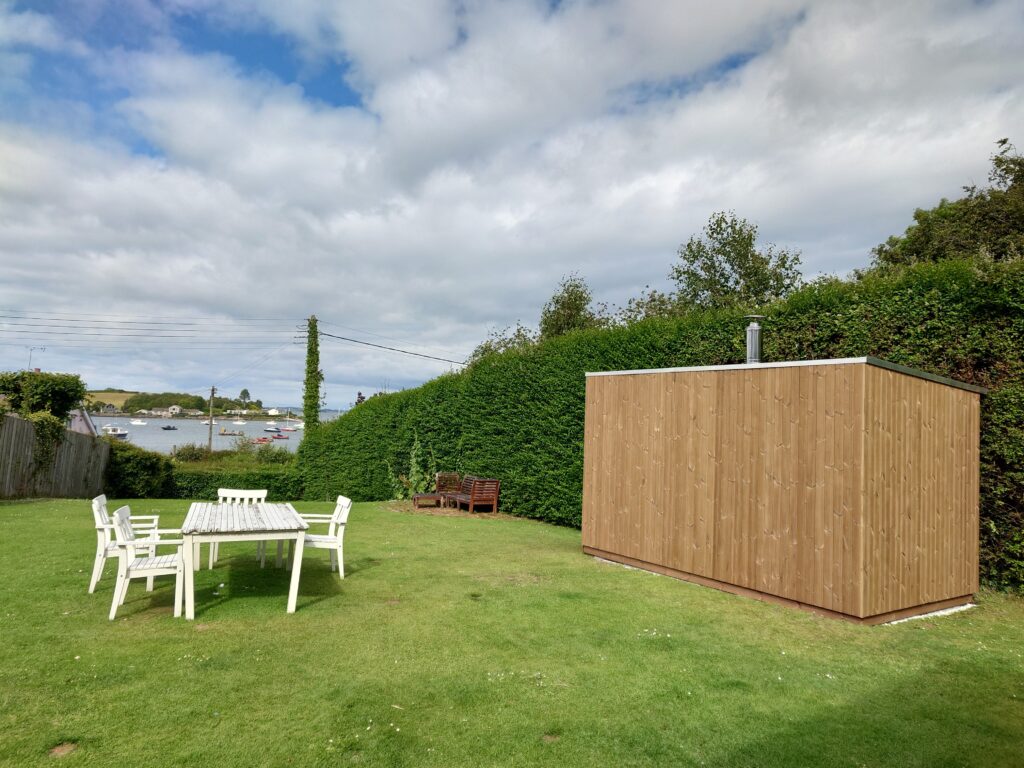
A timber outdoor sauna sited against a tall hedge for shelter at the edge of a lawn, with garden furniture nearby.

Trees and overhanging branches

A sauna tucked among trees can look wonderful, but overhanging branches drop leaves, sap and debris onto the roof and keep the timber damp. Roots can also disturb a base over time. Leave a sensible gap from large trees and keep branches trimmed back from the roof.

Boundaries and planning rules

Most garden saunas are permitted development, but position affects the rules, and they differ slightly across the UK. In Scotland, the permitted development rules say any part of the sauna within 1 metre of a boundary generally must not exceed 2.5 metres in height. In England, the same 2.5 metre limit applies anywhere within 2 metres of a boundary. Placing a sauna forward of a house wall that faces a road, or living in a listed building or conservation area, can also change things. Our guide to planning permission for a garden sauna explains the rules in plain English.

Extra considerations for wood-fired saunas

A wood-burning stove needs a flue with safe clearances from the sauna roof, nearby trees and other buildings. Think about where the smoke will drift, both for your own comfort and your neighbours’. If you live in a smoke control area, check with your local council which stoves and fuels you can use before you commit to a location.

Somewhere to cool off

Half of the sauna experience happens outside the cabin. Leave room for a deck or patio to sit on between rounds, and if you want an outdoor shower or cold plunge, plan for its water supply and drainage at the same time as the sauna.

Access for installation

Finally, think about how the sauna and its base will get there. Narrow side passages, steps and steep slopes can affect how a sauna is delivered and built, so measure the route before you settle on the spot at the bottom of the garden.

Outdoor sauna location: common questions

How close to a fence can an outdoor sauna be?

You can place a sauna close to a boundary, but height limits apply. Under permitted development, a sauna is generally limited to 2.5 metres in height within 1 metre of a boundary in Scotland, or within 2 metres of a boundary in England. Leave enough space to reach the walls for maintenance, and keep the flue of a wood-fired stove well clear of fences and neighbouring property.

Can an outdoor sauna sit on decking?

It can, as long as the decking is designed to carry the weight of the sauna, the heater, the stones and the people using it. Many existing decks are not built for that load, so it is worth having the structure checked or building a dedicated base.

Does an outdoor sauna need a concrete base?

Not always. A concrete slab is a common and reliable choice, but paving or ground screws can work well too, depending on the ground and the size of the sauna. The key is that the base is level, firm and well drained.

How far from the house is too far?

There is no fixed rule, but every extra metre adds to the cost of running power and to the walk on a winter night. Most people find the sweet spot is close enough to reach comfortably in a towel and far enough to feel like an escape.

Putting it all together

The perfect location balances all of these, and the right answer is different for every garden. Our complete UK guide to garden saunas covers sizing, styles and design alongside siting, and our sauna cost guide explains how groundwork and electrics feed into the overall budget.

Let us help you find the right spot

Skotlanti designs and builds bespoke outdoor saunas made to suit your garden, your view and the way you like to relax. Get in touch with Skotlanti and we will help you choose the best location for your sauna from the very first conversation.

How Much Does It Cost to Run a Sauna?

One of the first questions people ask once they start pricing up a home sauna is what it will cost to run. The good news is that the answer is usually smaller than expected. For most electric saunas in the UK, a session costs somewhere between a few pence and a few pounds, depending on the type of sauna, the size of the heater and how long you use it. This guide shows you how to work out the real number for your own sauna, with worked examples at current UK electricity prices.

The simple formula

Every electric sauna follows the same sum:

heater power (kW) x hours switched on x your electricity unit rate = cost per session

The heater’s power rating is on its spec sheet. The unit rate is on your electricity bill. For reference, the Ofgem price cap from 1 October to 31 December 2026 sets an average electricity unit rate of 26.32p per kWh for customers paying by direct debit. Your own tariff may be higher or lower, and the cap changes every quarter, so it is always worth plugging in your own figure.

What a session really costs

The figures below are a ceiling, not an average. They assume the heater runs at full power for the whole time, from switching on to switching off, at 26.32p per kWh. In practice your sauna will cost less than this, because once the cabin reaches temperature the thermostat cycles the heater on and off to hold it there rather than running flat out.

  • Infrared cabin (around 2 kW), one hour including warm-up: 2 kWh, so no more than about 53p a session.
  • Traditional sauna with a 6 kW heater, 45 minutes to heat plus a 45 minute session: 9 kWh, so no more than about £2.37 a session.
  • Larger traditional sauna with a 9 kW heater, an hour to heat plus an hour of use: 18 kWh, so no more than about £4.74 a session.

Used three times a week, that works out at no more than roughly £7 a month for the infrared cabin, £31 a month for the 6 kW sauna and £62 a month for the larger 9 kW build. If you are weighing up the two types of heat, our guide to how infrared saunas work explains why they draw so much less power.

What pushes the cost up or down

Heater size

Heaters are sized to the volume of the cabin. A heater that is too small has to work harder and for longer to reach temperature, while one that is properly matched heats the room efficiently and then idles. A bespoke build lets the heater be specified for the exact space rather than a standard box.

Insulation and build quality

This is the biggest factor most people overlook. A well-insulated, well-sealed cabin holds its heat, so the heater spends less time switched on during your session. Poor insulation, gaps around the door and thin walls all leak heat and money.

Indoor or outdoor

An outdoor sauna starts from a colder baseline in winter, so it takes longer to warm up on a cold Scottish evening than an indoor sauna sitting inside a heated house. Good insulation narrows that gap considerably.

How long you heat it before you get in

Warm-up is usually the most energy-hungry part of any session, because the heater runs at full power the whole time. Switching on at the right moment, ideally with a timer or app control, avoids paying to heat an empty sauna.

What about wood-fired saunas?

A wood-fired stove uses no electricity for heat, so the running cost is the cost of your logs. That can be very economical if you have a good local supply of seasoned hardwood, and it keeps working during a power cut. The trade-off is more hands-on effort to light and tend the fire. Our comparison of wood-fired vs electric sauna heaters covers the pros and cons in full.

The smaller ongoing costs

Beyond energy, the running costs of a sauna are modest. Sauna stones settle and crack over time and need replacing every so often, the timber benefits from regular cleaning and the occasional treatment, and an outdoor sauna needs its exterior looked after like any garden building. None of these are large, and a quality build keeps them to a minimum.

Five ways to keep running costs down

  • Choose the right heater size for the cabin rather than the biggest one available.
  • Invest in insulation and a well-sealed door. It pays back every session.
  • Use a timer or remote control so the sauna is ready when you are, and not before.
  • Keep the door closed while heating and between rounds.
  • Share sessions with family or friends, since the warm-up cost is the same however many people use it.

Running costs in context

For most households, the running cost of a sauna is small next to the upfront cost of buying and installing one. Our UK sauna cost guide breaks down what to expect to pay for the sauna itself, and if you are wondering how many sessions to budget for, see how often you should use a sauna.

Sauna running costs: common questions

Does a sauna use a lot of electricity?

A traditional electric heater draws a lot of power while it is heating, typically 6 to 9 kW for a home sauna, but only for a short time. Because sessions are short and the thermostat cycles the heater once the room is hot, the total energy used per session is modest. For most households it is a small line on the bill rather than a large one.

Is an infrared sauna cheaper to run?

Yes. Infrared panels draw far less power than a traditional heater and warm up in a fraction of the time, so the cost per session is usually measured in pence. The experience is different, with gentler air temperatures and no steam, so it is worth comparing infrared and traditional saunas before deciding on cost alone.

Do I need a special electricity supply?

Most traditional sauna heaters need their own dedicated circuit, installed and certified by a qualified electrician. Smaller infrared cabins can sometimes run from a standard supply, but always follow the manufacturer’s specification. A reputable installer will confirm what your home needs as part of the design.

Can solar panels cover the cost?

If you have solar panels, running the sauna during daylight hours can use energy you have generated yourself, which reduces what you draw from the grid. How much it helps depends on the size of your system, the time of year and when you like to use the sauna.

A sauna built to be efficient

Skotlanti designs and builds bespoke indoor saunas and outdoor saunas with properly sized heaters and well-insulated cabins, so they are a pleasure to use and sensible to run. Get in touch with Skotlanti and we will help you find the right setup for your home.

Sauna After a Workout: Recovery Benefits

Finishing a training session with time in the sauna is a ritual for athletes across the Nordic countries, and it is catching on fast in the UK. But does a sauna after a workout actually help you recover, or does it just feel good? This guide looks at what the research says about the recovery benefits, whether you should go before or after exercise, and how to do it safely.

Why a sauna after exercise feels so good

After a workout your muscles are warm, your heart rate is coming down and your body is beginning to repair itself. Sitting in the heat relaxes tight muscles, encourages blood flow to the skin and gives you a quiet, screen-free space to wind down. For many people the mental reset is as valuable as anything physical, turning the end of a hard session into something to look forward to.

What the research says about recovery

The science on post-workout sauna use is still growing, and most studies are small, but a few findings stand out.

Endurance performance

One of the best-known studies, published in the Journal of Science and Medicine in Sport in 2007, followed six competitive male distance runners. After training, they sat in a sauna at around 90°C for roughly 30 minutes, about 13 times over three weeks. Their run time to exhaustion improved by 32%, which the researchers estimated was equal to about a 1.9% improvement in an endurance time trial. Their blood plasma volume also rose by around 7%, which is thought to be the main reason, since more plasma helps the body manage heat and deliver oxygen during exercise. It is a small study, so the result should be treated as promising rather than proven.

Muscle recovery and soreness

A 2023 study in Biology of Sport gave 16 male basketball players a 20 minute infrared sauna session at around 43°C after a demanding strength and jumping workout. Compared with resting normally, the sauna group kept more of their explosive jumping performance the next day and reported less muscle soreness and a greater sense of recovery.

Not every study finds a benefit for every type of training. A 2015 study in SpringerPlus found that a far-infrared sauna session helped neuromuscular recovery after endurance exercise, but made no measurable difference after a strength session. The honest summary is that a sauna is likely to help some people recover from some kinds of training, and is unlikely to do any harm when used sensibly.

The wider picture

Beyond training, regular sauna bathing is linked with a range of wider health benefits, from relaxation and better sleep to cardiovascular health. Our evidence-led guide to sauna health benefits covers what the research shows in more detail.

Sauna before or after a workout?

For most people, after is the better choice. A long, hot sauna before training raises your core temperature and causes you to lose fluid through sweat, which can leave you feeling tired and less able to perform. Saving the sauna for afterwards means you train at your best and then use the heat to relax and recover.

A short, gentle sauna before exercise can work as a warm-up for some people, particularly on a cold day, but keep it brief and make sure you are well hydrated before you start training.

How to use a sauna after your workout

  • Cool down first. Give your heart rate 10 to 15 minutes to settle after hard exercise before you step into the heat.
  • Rehydrate before and after. You will already have lost fluid training, so drink water before your session and replace fluids afterwards.
  • Keep it to 10 to 20 minutes. There is no need for marathon sessions. Two shorter rounds with a cool-down in between work well.
  • Finish with a cool shower and let your body return to normal temperature before you head off.

Our guide to how to use a sauna covers timing, temperature and etiquette in more depth, and if you want to build it into your training week, see how often you should use a sauna.

Staying safe

Step out straight away if you feel dizzy, faint or unwell. Avoid alcohol before or after a session. If you have a heart condition, low blood pressure, are pregnant, or take medication that affects blood pressure or hydration, talk to your GP before adding sauna sessions to your routine.

Sauna after a workout: common questions

How long after a workout should I use the sauna?

Give yourself 10 to 15 minutes to cool down, rehydrate and let your heart rate settle first. After that, the sauna can be a natural next step, whether straight after your session or later the same day.

Can a sauna help with sore muscles?

Many people find the heat eases stiffness, and some research, including the 2023 basketball study above, has found reduced soreness after a sauna session. The evidence is not yet strong enough to promise a result, but it is a pleasant and low-risk way to help your body wind down.

Does a sauna after exercise help with weight loss?

The weight you lose in a sauna is almost entirely water, which comes straight back when you rehydrate, as it should. A sauna is a recovery and wellbeing tool, not a fat-loss one.

Sauna or ice bath after training?

Both are popular and many people enjoy alternating heat and cold. One thing to know if you are training for strength: research published in The Journal of Physiology suggests that regular cold water immersion straight after strength training may blunt longer-term muscle gains. If building strength is your main goal, it may be worth saving cold plunges for rest days and enjoying the sauna after lifting.

Is it safe to use the sauna every day after training?

Plenty of regular users do, keeping sessions moderate and staying well hydrated. Listen to your body, build up gradually, and take a day off if you feel run down.

Make recovery part of your routine at home

The easiest way to make post-workout sauna a habit is to have one a few steps from your door. Skotlanti designs and builds bespoke saunas for homes and gardens across the UK, sized for one person or the whole family. Explore Skotlanti saunas and see what would suit your space.